
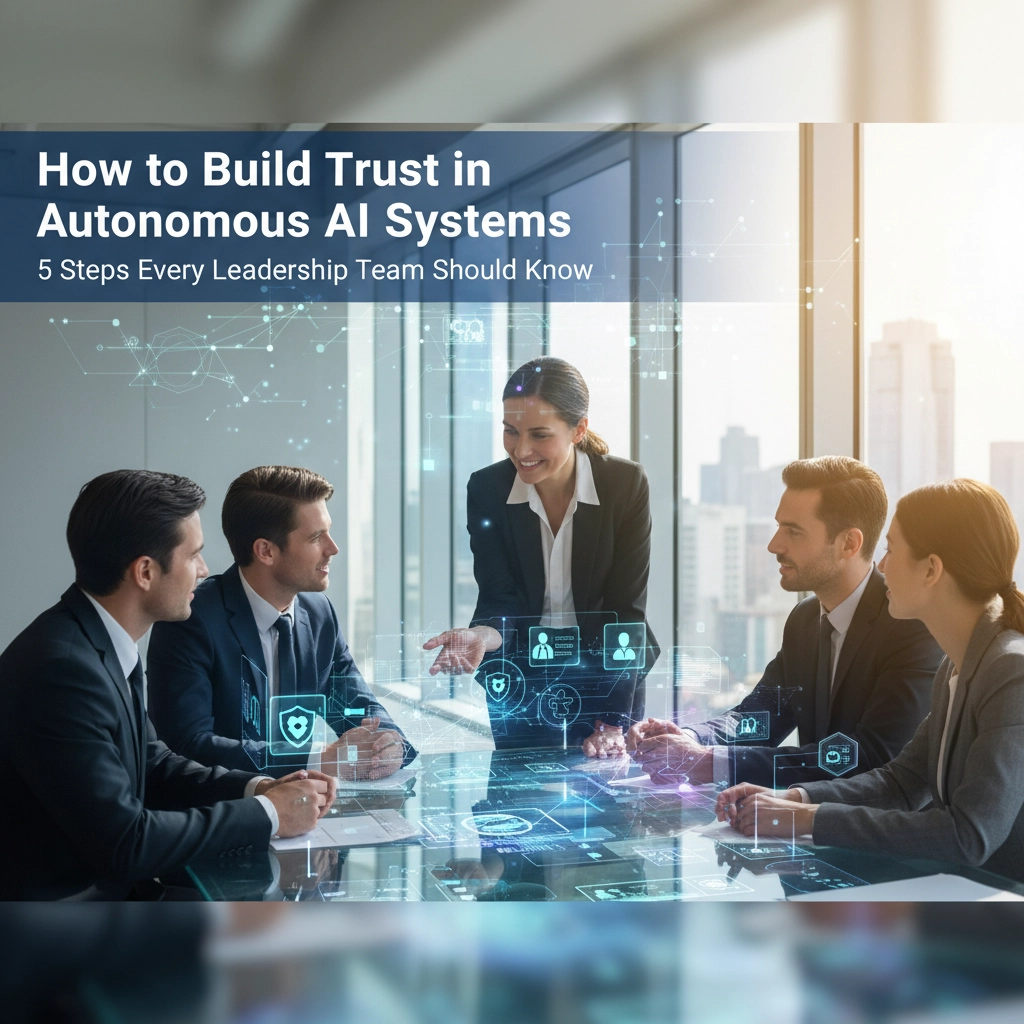
The promise of autonomous AI systems is transformative: intelligent agents that can make decisions, execute processes, and deliver results without constant human intervention. Yet for all their potential, these systems face a critical barrier: trust. Without it, even the most sophisticated AI remains underutilized, creating expensive technology investments that fail to deliver meaningful business value.
Research reveals that 77% of executives agree AI's true benefits require a solid foundation of trust across the enterprise, while 81% acknowledge that trust strategy must evolve alongside technology strategy. The challenge isn't just technical: it's organizational, cultural, and deeply human.
Leadership teams today must navigate this trust gap strategically. You cannot simply deploy autonomous AI and hope stakeholders will embrace it. Trust must be architected, cultivated, and maintained through deliberate action. Here are five essential steps to build that foundation.
Step 1: Establish Radical Transparency in AI Decision-Making
Autonomous AI systems operate as black boxes at your own peril. Your first priority must be making these systems fundamentally understandable to stakeholders across your organization. This means going beyond basic reporting to create true explainability in how algorithms operate, what data they consume, and how they arrive at decisions.
Think of transparency as your competitive advantage, not a burden. When teams can verify and understand AI outputs, they gain the confidence to build upon them rather than work around them. Document decision workflows clearly. Surface model logic in accessible formats. Ensure your AI systems can explain not just what they decide, but why they decided it.

Consider how companies like Accenture are implementing this principle through autonomous marketing agents that work alongside human marketers. The key difference: complete visibility into the AI's decision-making process, which strengthens collaboration rather than creating uncertainty.
Your action item: Audit your current AI systems for explainability gaps. Can a non-technical stakeholder understand how your AI reaches its conclusions? If not, this becomes your immediate priority.
Step 2: Design Human Oversight That Actually Works
Autonomy does not mean abandonment: this principle separates successful AI implementations from failures. The National Institute of Standards and Technology emphasizes that effective human oversight ensures AI systems remain aligned with organizational values while maintaining the ability to intervene when necessary.
Your leadership challenge lies in defining clear boundaries. What can your AI decide independently? When must human judgment intervene? These aren't technical questions: they're strategic business decisions that require executive-level attention.
Deploy ethical AI teams tasked with overseeing AI practices and ensuring compliance with organizational standards. These teams should have real authority to pause, redirect, or override AI decisions when situations demand human intervention. Without this governance layer, you risk unintended consequences that can destroy trust overnight.
"The most successful autonomous AI implementations treat human oversight not as a limitation, but as a strategic capability that enhances system performance."
Your framework should address high-stakes scenarios explicitly. Emergency protocols, escalation pathways, and clear accountability structures transform autonomous AI from a risk into a strategic asset.
Step 3: Embed Security as Your Foundation, Not an Afterthought
Trust becomes impossible without security, and autonomous AI systems operating in real-time environments present unique vulnerabilities. Your security approach must be foundational: built by design from the start of development, not added as an afterthought.
This requires more than traditional cybersecurity measures. You need secure data flows, controlled system interfaces, and strict access governance that can operate at the speed of autonomous decision-making. Implement policies that limit unauthorized access, encrypt sensitive data throughout its lifecycle, and ensure AI agents operate within clearly defined guardrails.

The stakes are particularly high because compromised autonomous systems can cause cascading failures across your organization. A security breach in a traditional system might expose data; a breach in an autonomous AI system could trigger incorrect decisions at scale before anyone notices.
Your security framework should include:
- Multi-layered authentication for AI system access
- Real-time monitoring of AI agent behavior patterns
- Automated threat detection specifically calibrated for AI systems
- Regular penetration testing focused on AI-specific vulnerabilities
Remember: even well-designed autonomous systems become liability without proper safeguards.
Step 4: Institute Rigorous Monitoring and Auditing Practices
Autonomous AI systems can produce unintended results: inaccuracies, biases, or harmful decisions: often faster than traditional systems. Your monitoring approach must match the speed and complexity of autonomous decision-making while maintaining the rigor necessary to catch problems before they escalate.
Establish auditing processes that can detect when systems are underperforming or making questionable decisions in real-time. This includes sophisticated false positive reduction through contextual data analysis, ensuring that legitimate alerts retain credibility and operators continue trusting the system's warnings.
Your monitoring strategy should encompass:
- Real-time performance dashboards with meaningful metrics
- Automated bias detection across decision patterns
- Regular model drift analysis and correction protocols
- Clear escalation pathways when anomalies are detected

Deploy strict access controls that ensure only authorized users can interact with AI systems, but make these controls intelligent enough to avoid hindering legitimate business processes. The goal is vigilance without bureaucracy.
Critical insight: Monitoring isn't just about catching errors: it's about maintaining stakeholder confidence through demonstrated accountability.
Step 5: Cultivate Partnership, Not Replacement
Trust in autonomous AI rests on two distinct foundations: cognitive trust based on demonstrable competence and consistency, and emotional trust based on perceived alignment with organizational goals and values. Your leadership approach must address both dimensions strategically.
Position AI agents as partners that eliminate routine burdens, allowing your teams to focus on higher-value work rather than competing with human capabilities. When workers recognize that AI enhances their abilities rather than threatening their relevance, resistance transforms into advocacy.
Roll out autonomy gradually, allowing teams to build confidence incrementally rather than demanding immediate adoption. This approach acknowledges that trust develops over time through positive experiences, not through mandate.
"The organizations that succeed with autonomous AI treat implementation as a journey of partnership building, not a technology deployment."
Focus on creating early wins that demonstrate clear value while building comfort with AI decision-making. Success stories from within your organization will prove more persuasive than external case studies.
Your change management strategy should emphasize:
- Clear communication about how AI augments rather than replaces human judgment
- Training programs that build AI literacy across your organization
- Recognition and rewards for successful human-AI collaboration
- Regular feedback loops that inform AI system improvements
The Strategic Imperative
Building trusted autonomous AI requires sustained organizational commitment that extends far beyond initial deployment. View trust not as a checkbox to complete, but as an ongoing competitive advantage that demands continuous attention to data quality, privacy protection, transparency, and security.
Organizations that embed these principles into their AI strategy will reduce implementation risks, accelerate business value realization, drive adoption across teams, and position themselves as leaders in an increasingly AI-driven economy.
The question isn't whether autonomous AI will reshape your industry: it's whether your organization will lead that transformation or struggle to catch up. Trust becomes your differentiator, and these five steps provide your roadmap to building it systematically.
Your next move: assess where your organization stands on each of these dimensions today. The gaps you identify will become your strategic priorities for tomorrow.