
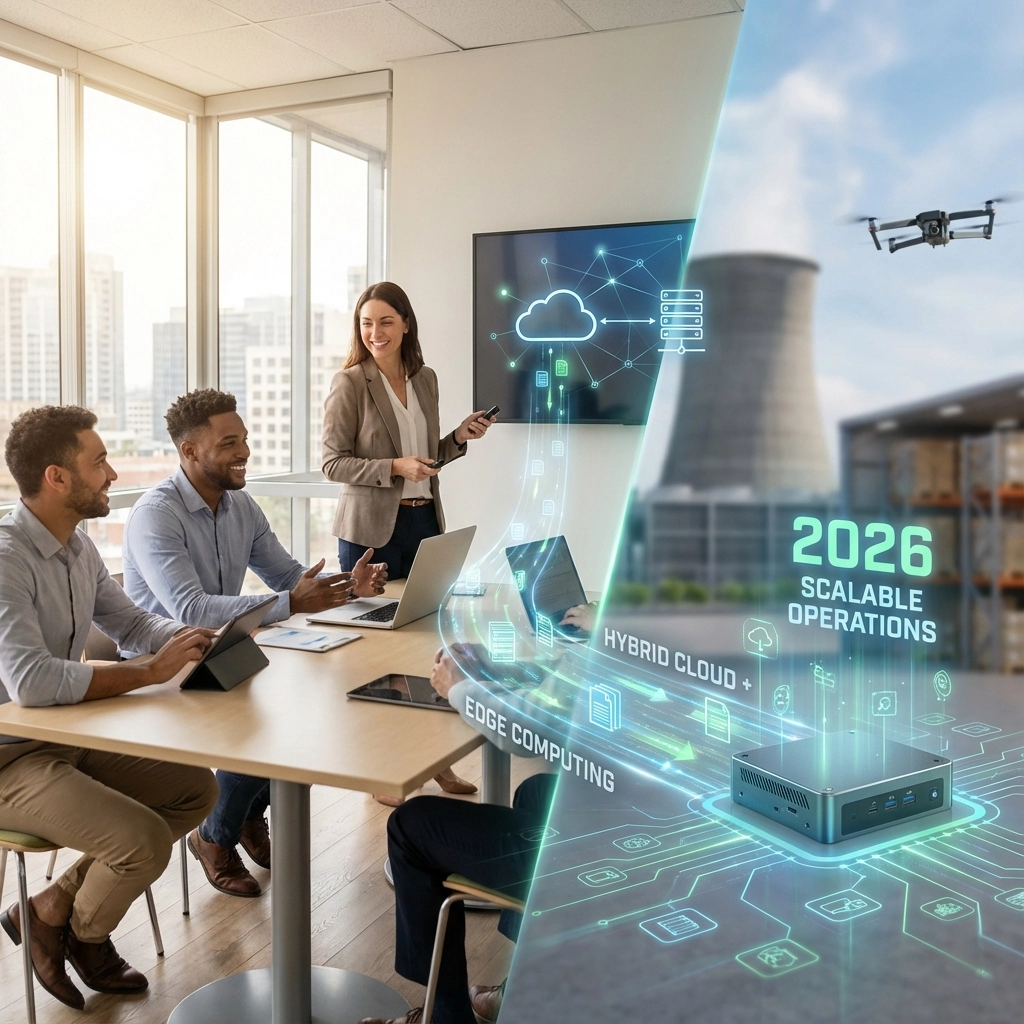
The technology landscape of 2026 isn't about choosing between cloud and on-premises infrastructure anymore: it's about strategically orchestrating both with edge computing to create resilient, scalable operations. Organizations that master this hybrid approach will outpace competitors who remain locked into single-platform thinking.
Why 2026 Marks the Hybrid Cloud Tipping Point
The convergence of hybrid cloud and edge computing represents more than just infrastructure evolution: it's a fundamental shift in how enterprises process data, deliver applications, and scale operations. By 2026, cloud-native development will completely dominate enterprise software strategies, with containers, Kubernetes, and serverless computing becoming the default building blocks for scalable applications.
"The organizations that view hybrid cloud and edge computing as integrated components of a cohesive strategy: rather than separate initiatives: will achieve superior agility and performance."
Three critical factors are driving this transformation:
- AI workload demands requiring specialized infrastructure with higher GPU-to-CPU ratios
- Real-time processing needs from IoT devices generating massive data streams
- Regulatory compliance requiring data to remain in specific geographic locations while leveraging cloud elasticity

The Three-Tier Architecture Strategy That Works
Forward-thinking enterprises are implementing sophisticated three-tier hybrid architectures specifically designed for AI and modern workloads:
Public Cloud for Elasticity and Innovation
Deploy your variable training workloads, burst capacity needs, and experimentation phases in hyperscale environments. Public cloud excels when existing data gravity makes cloud deployment logical and when you need access to cutting-edge AI services that simplify management of rapidly evolving model architectures.
Key applications:
- Machine learning model training and experimentation
- Development and testing environments
- Seasonal workload bursts
- Global application deployment
Custom-Built AI Data Centers
These specialized facilities feature evolved architectures including higher ratios of GPUs to CPUs, new server models optimized for hybrid workloads, advanced form factors enabling rapid deployment, and optical networking between processors for reduced latency.
Critical capabilities:
- GPU-heavy workloads with specialized cooling systems
- High-bandwidth networking infrastructure
- Modular designs for energy-efficient deployment
- Heat reuse systems for operational efficiency
Edge and On-Premises Infrastructure
Local systems handle real-time decision-making, compliance-sensitive operations, and latency-critical applications such as autonomous vehicles, smart factories, and connected healthcare systems.
Strategic advantages:
- Sub-millisecond response times for critical applications
- Data sovereignty and compliance control
- Reduced bandwidth costs for high-volume data processing
- Operational continuity during network disruptions
Distributed Hybrid Infrastructure: The New Operating Model
Distributed Hybrid Infrastructure (DHI) delivers cloud-native capabilities across on-premises, edge, and public cloud environments through a unified framework. This approach moves beyond traditional binary cloud-versus-on-premises thinking by providing standardized infrastructure platforms capable of accommodating various deployment scenarios.
DHI enables you to transition between deployment options seamlessly based on:
- Workload requirements and performance characteristics
- Compliance and regulatory mandates
- Cost optimization opportunities
- Business continuity needs

Security and Resilience: The Foundation Layer
Zero-Trust Architecture Implementation
Implement zero-trust architecture with software-defined networking that delivers built-in micro-segmentation for enhanced layered security. This approach treats every connection as potentially compromised, requiring verification regardless of location or previous trust levels.
Core components include:
- Identity and access management across all environments
- Network segmentation and micro-perimeters
- Continuous monitoring and threat detection
- Policy-based access controls
Confidential Computing Advancement
Confidential computing extends encryption end-to-end across data, models, and operations: ensuring sensitive information remains protected throughout the entire workflow. This becomes critical as AI workloads process increasingly sensitive data sets.
Business Continuity Through Stretched Clusters
Deploy stretched cluster technology with synchronous replication to enable automatic failover between geographically distributed sites. This supports near-zero downtime requirements for mission-critical applications while maintaining data consistency.
Cloud-Native Development: Your Competitive Advantage
The tools dominating enterprise development by 2026 include Kubernetes, Argo CD, Istio, Terraform, and AWS Copilot: enabling automation, scaling, and continuous deployment at unprecedented efficiency.
Master these capabilities:
- Container orchestration across hybrid environments
- GitOps workflows for automated deployment pipelines
- Service mesh management for microservices communication
- Infrastructure as code for consistent environment provisioning
- Observability and monitoring across distributed systems
Organizations now run Kubernetes and containerized workloads alongside traditional virtual machines with consistent operations, security, and lifecycle management across hybrid environments.

AI-Optimized Infrastructure: Preparing for Tomorrow
As AI adoption expands, organizations face infrastructure bottlenecks requiring new approaches to data center design and management. Leading companies are exploring data centers of the future that accommodate:
- Specialized cooling systems for high-density GPU clusters
- High-bandwidth networking with optical interconnects
- Modular deployment models enabling rapid scaling
- Energy-efficient operations with heat reuse capabilities
"Success requires viewing infrastructure not as a cost center, but as the foundation that enables your organization's competitive advantages."
Operational Management: New Skills for New Infrastructure
Managing hybrid architectures requires new categories of expertise and management tools. Legacy orchestration solutions are being replaced with platforms specifically designed for modern workloads: managing not only traditional virtual machines and containers but also specialized hardware like GPUs and emerging processor types.
Critical skill development areas:
- AI-optimized infrastructure operations
- GPU cluster management and optimization
- High-bandwidth networking configuration
- Specialized cooling system management
- Multi-cloud orchestration and governance
Implementation Roadmap for 2026 Success
Phase 1: Assessment and Strategy (Months 1-3)
Map your current infrastructure landscape and identify workloads suitable for hybrid deployment. Assess your specific strategy: are you transitioning to public cloud, moving away from it, or adapting on-premises infrastructure? Your answer determines investment priorities and technology selection.
Phase 2: Foundation Building (Months 4-8)
Deploy core infrastructure components including container orchestration platforms, identity management systems, and network segmentation tools. Establish consistent operations, security, and lifecycle management across all environments.
Phase 3: Workload Migration and Optimization (Months 9-18)
Migrate applications systematically based on their requirements, compliance needs, and performance characteristics. Implement multi-cloud integration management platforms that unify operations across multiple cloud providers while maintaining security and compliance.
Phase 4: Advanced Capabilities and Innovation (Months 19-24)
Deploy AI-optimized infrastructure and advanced analytics capabilities. Implement predictive cybersecurity that transforms from reactive function into predictive capability that anticipates and prevents threats before they occur.

Predictive Cybersecurity: The Next Frontier
The shift toward continuous, intelligent monitoring transforms enterprise cybersecurity from reactive to predictive. This proactive stance extends across distributed hybrid environments, protecting data whether it resides on-premises, at the edge, or in public clouds.
Key capabilities include:
- Behavioral analytics that identify anomalous patterns
- Threat intelligence integration across all environments
- Automated response systems that contain threats instantly
- Compliance monitoring that ensures regulatory adherence
Your Next Steps: Building Competitive Advantage
Navigate the complexity by focusing on these strategic priorities:
- Develop hybrid-first thinking across your technology teams
- Invest in multi-cloud management platforms that provide unified operations
- Build edge computing capabilities for latency-critical applications
- Establish zero-trust security frameworks from the ground up
- Create centers of excellence for hybrid infrastructure management
The organizations that master hybrid cloud and edge computing convergence will achieve superior agility, resilience, and performance while maintaining cost efficiency and control. Start building your 2026 infrastructure advantage today: because your competitors already are.
"The question isn't whether you'll adopt hybrid cloud and edge computing, but whether you'll lead with it or follow behind."
Ready to develop your hybrid cloud and edge computing strategy? Contact our team at TechStrategy Innovations to discuss how we can help you build the infrastructure foundation for 2026 success.