
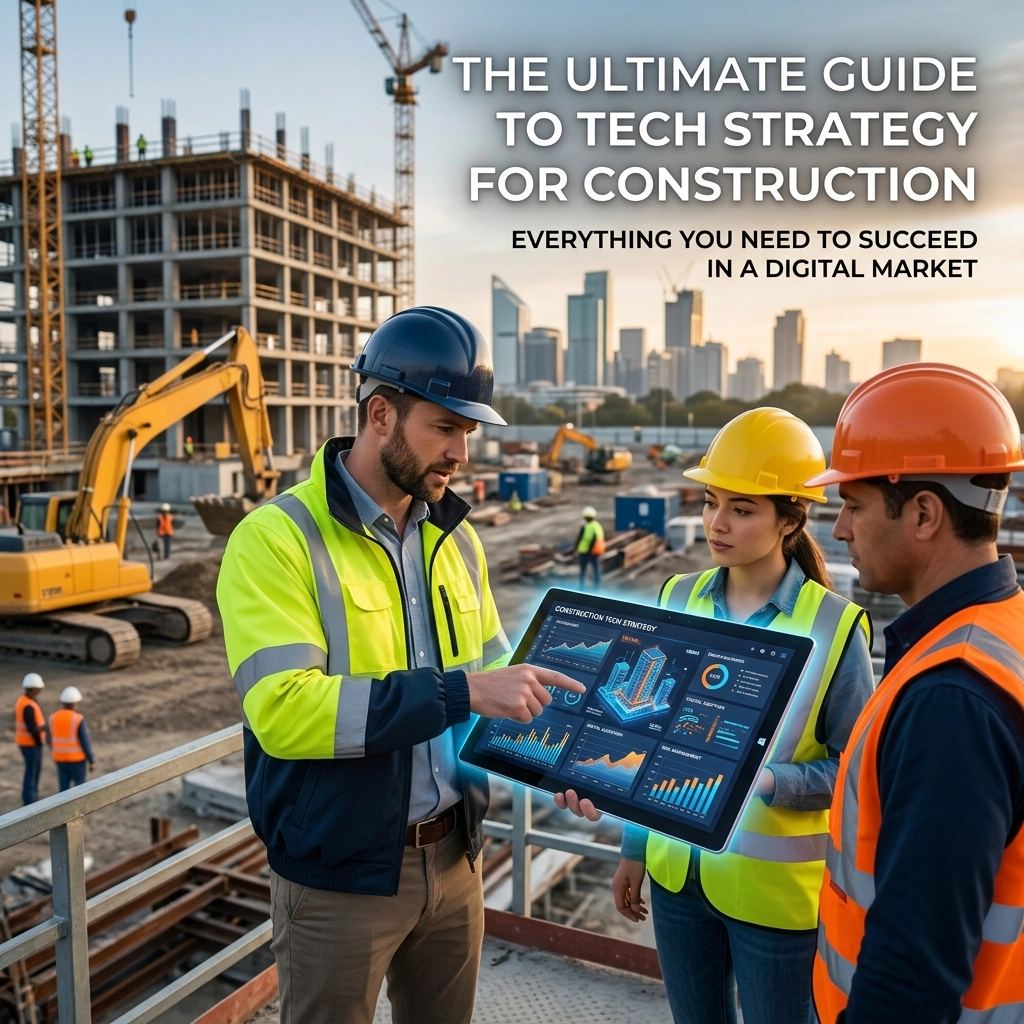
The construction industry has long been defined by grit, steel, and physical labor. But as we move deeper into 2026, the blueprint for success has shifted. It is no longer enough to have the best heavy machinery or the most skilled foremen; you must have a robust digital infrastructure that supports every brick laid and every dollar spent.
In a market where margins are tightening and labor shortages are the new baseline, technology is the only lever left to pull for exponential growth. This guide outlines how to build a tech strategy that doesn't just "digitize" your mess, but optimizes your entire operation for a competitive, high-tech future.
1. The 2026 Reality: Why Your Current Strategy is Lagging
The gap between "tech-enabled" firms and "traditional" firms is widening into a canyon. By now, most companies use some form of CAD or basic project management software. However, the leaders in the space are moving toward integrated ecosystems.
To succeed today, you must recognize that construction is now a data business. Every sensor on a crane, every entry in a time-tracking app, and every scan from a drone is a data point that should be driving your next bid.
"Technology in construction isn't just about building faster; it's about building smarter with data that lasts longer than the concrete."
The Challenges You Face:
- Legacy Mindsets: "We've always done it this way" is the most expensive phrase in construction.
- Fragmented Data: Having information trapped in siloes (spreadsheets, emails, paper) prevents real-time decision-making.
- Scalability Issues: Without a cloud-native foundation, your tech can't handle the influx of data from 2026-era tools like IoT and 4D simulations.

2. The Core Pillars of a Digital Construction Roadmap
Before you deploy high-end robotics or AI, you must stabilize your foundation. A strategic tech stack is built on four essential pillars:
I. Cloud-Native Infrastructure
The era of the local server is over. To enable real-time collaboration between the field and the office, your infrastructure must be accessible from anywhere. This is the first step in ensuring your team stays synchronized. If you aren't sure if your foundation is ready, you need to evaluate why an AI-native roadmap is necessary in 2026.
II. Integrated Software Ecosystems
Stop buying point solutions that don't talk to each other. Your estimating software should feed into your project management tool, which should automatically update your accounting ledger.
- ERP (Enterprise Resource Planning): The "brain" of your business.
- BIM (Building Information Modeling): Moving beyond 3D to 4D (time) and 5D (cost).
- CRM: Managing the pipeline and client expectations strategically.
III. Data Governance
Establish who owns the data, how it is collected, and how it is protected. As construction firms become targets for cyberattacks, your privacy policy and data security measures are no longer "IT problems": they are business imperatives.
IV. Continuous Upskilling
Your tech is only as good as the person holding the tablet. Create a culture of continuous learning to ensure your workforce can navigate new interfaces without losing productivity.
3. High-Impact Technologies to Deploy Now
If you want to dominate the digital market, you need to look beyond standard project management. The following technologies are the current standard-setters for 2026.
Multiagent AI and Autonomy
We are seeing the rise of AI agents that don't just "suggest" schedules but actively coordinate between vendors and subcontractors. These agents can predict supply chain delays before they happen and re-route deliveries automatically. However, this requires significant compute power. Check if your infrastructure needs an upgrade before 2027 to support these autonomous systems.
Digital Twins and IoT
Deploying digital twins allows you to simulate the entire lifecycle of a building before a shovel hits the dirt. By integrating IoT sensors into the actual structure, you provide owners with a "living" document of the building’s health, opening new revenue streams in facility management.
Robotics and Prefabrication
- Drones: For site surveying and safety inspections.
- Exoskeletons: To reduce worker fatigue and injury on-site.
- 3D Printing: For complex architectural elements that are too costly to cast traditionally.

4. Building the Stack: A Strategic Selection Process
Don't let a salesperson dictate your strategy. Use a disciplined approach to selecting your tech stack:
- Articulate the Friction: Identify exactly where money is leaking. Is it in the bidding process? Is it field-to-office communication?
- Map the Power Dynamics: Who are the gatekeepers in your organization? Secure their buy-in by showing them how the tech makes their specific job easier.
- Think Beyond the Moment: Choose vendors that offer open APIs (Application Programming Interfaces). You want tools that grow with you, not tools that lock you into a proprietary cage.
- Leverage Fractional Leadership: Most construction firms don't need a $250k/year full-time CTO, but they do need expert guidance. Consider the benefits of a Fractional CTO vs. a full-time hire to navigate these complex choices.
"A digital strategy without a cultural roadmap is just an expensive way to fail."
5. Overcoming the "Adoption Friction"
The greatest barrier to tech in construction isn't the cost; it's the culture. To successfully deploy new tools, you must control the narrative.
- Pilot Small, Scale Fast: Don't roll out a new ERP across all twenty active jobsites at once. Pick one "tech-forward" team, run a pilot, and use their success as an internal case study to convince the skeptics.
- Direct, Imperative Training: Don't give "optional" webinars. Integrate tech training into your mandatory safety and operational briefings. Make it part of the job.
- Focus on the Workforce: Be transparent about how AI and robotics will assist workers, not replace them. For more on this, look at our blueprint for workforce upskilling.

6. Measuring Success: ROI in a Digital World
In 2026, "it feels faster" is not a metric. You must be able to prove the ROI of every tech investment to stakeholders and investors. We’ve entered a cycle where outcomes matter more than ever.
Key Performance Indicators (KPIs) to Track:
- Reduction in RFI Turnaround Time: How much faster are questions getting answered?
- Rework Percentage: Are digital twins and BIM reducing on-site errors?
- Bidding Win Rate: Is AI-assisted estimating helping you bid more accurately and more often?
- Labor Productivity Ratio: Are your teams doing more with the same amount of hours?

7. The Forward-Looking Perspective
The digital market for construction is not a trend; it is the new reality. As we look toward 2027 and beyond, the companies that thrive will be those that viewed technology as a strategic asset rather than an overhead expense.
You need to move from being a "builder who uses tech" to a "tech-driven builder." This requires a shift in how you fund projects, how you hire talent, and how you present your value to clients.
Your Next Steps:
- Audit your current "Shadow IT": Find out what apps your foremen are using behind your back: this is where your real needs are.
- Define your North Star: What is the one operational bottleneck that, if solved, would double your capacity?
- Consult an Expert: Don't guess. Connect with TechStrategy Innovations to build a roadmap that actually delivers results.
The market doesn't wait for the slow. Optimize your strategy, deploy your stack, and lead the digital evolution of the jobsite.
Ready to turn your tech spend into measurable ROI? Schedule a consultation with our team today.