

For years, leaders evaluated UCaaS and CCaaS as separate purchasing decisions. UCaaS supported employees with calling, messaging, meetings, and presence. CCaaS managed customer queues, routing, IVR, agent desktops, and omnichannel service.
That distinction still matters at the product level. It no longer works as an operating model.
When UCaaS and CCaaS remain disconnected, your business pays for more than overlapping licenses. You also absorb slower escalations, duplicated administration, fragmented analytics, inconsistent customer journeys, and AI systems that cannot access the full context of an interaction.
The cost of disconnected communications is not confined to the IT budget. It appears in every delayed answer, repeated explanation, and unresolved customer issue.
1. See the hidden bill
A separate UCaaS and CCaaS environment can look financially responsible during procurement. Each platform may offer competitive pricing, strong features, and a clear business case.
The problem emerges after deployment. Your teams must connect the platforms through middleware, custom integrations, data exports, and manual workarounds.
The hidden costs typically include:
Duplicate technology
- Separate telephony infrastructure or carrier relationships
- Overlapping recording, transcription, analytics, and AI tools
- Multiple identity, access, and administrative systems
Duplicate operations
- Different teams managing UCaaS and CCaaS policies
- Separate vendor contracts and support escalations
- Multiple reporting environments with inconsistent definitions
Duplicate effort
- Agents re-entering customer information
- Employees searching across applications for the right expert
- Supervisors reconciling performance data manually
Avaya’s 2026 UCaaS research cites an estimated 20% to 30% additional cost for organizations maintaining disconnected UCaaS and CCaaS stacks compared with a converged approach. The precise number will vary by organization, but the pattern is consistent: integration debt grows when communication systems are designed in isolation.
Start by calculating your total cost of ownership, not just your subscription fees. Include implementation, support, administration, integration maintenance, training, downtime, and the labor cost of every manual handoff.

2. Know what you are separating
UCaaS and CCaaS serve different primary users, but their workflows increasingly overlap.
| Capability | UCaaS | CCaaS | Integrated foundation |
|---|---|---|---|
| Primary users | Employees and internal teams | Agents, supervisors, and service teams | Everyone involved in the customer journey |
| Core functions | Voice, video, messaging, presence, meetings | Queues, routing, IVR, channels, quality management | Shared communications, context, routing, and analytics |
| Primary objective | Employee productivity | Customer service efficiency | Faster resolution and better end-to-end experience |
| Typical data | Presence, calls, meetings, messages | Interaction history, recordings, cases, dispositions | Unified interaction and collaboration context |
| Common weakness when isolated | Limited visibility into customer operations | Difficulty reaching internal experts | Reduced duplication and stronger orchestration |
The customer does not care which department owns the next step. They care whether the person helping them has the information and authority to resolve the issue.
Suppose a customer calls about a billing problem that requires input from sales, legal, or product operations. In a disconnected environment, the agent may place the customer on hold, search for the right person, summarize the issue again, and create a callback task.
In a converged environment, presence and collaboration capabilities can help the agent locate the right expert quickly. The interaction history, customer context, and next action can remain connected.
3. Measure the experience drag
Disconnected platforms create friction in several predictable places.
Customer handoffs
Every transfer creates risk. The customer may need to repeat the issue, wait for an unavailable specialist, or move between channels without continuity.
Measure:
- Transfer rate
- Callback volume
- Hold time during escalations
- Repeat-contact rate
- First contact resolution
Agent productivity
Agents lose time when they must switch between the contact center desktop, collaboration tools, CRM, knowledge bases, and internal messaging applications.
Metrigy research summaries have reported approximately 30% higher agent productivity, 20% improvement in first contact resolution, and 15% higher customer satisfaction among organizations integrating UCaaS and CCaaS. Treat these figures as directional benchmarks, not guaranteed outcomes; your results depend on workflow design, adoption, data quality, and platform execution.
Reporting and decision-making
Separate systems produce separate versions of reality. Contact center leaders may track handle time and service levels, while IT tracks platform usage and employee adoption in another environment.
That makes it harder to answer strategic questions:
- Which internal teams create the most service delays?
- Where do escalations fail?
- Which channels produce the strongest outcomes?
- How much time do employees spend supporting customer-facing teams?
- Which automation opportunities would produce measurable savings?
AI performance
AI can summarize a call without understanding the full business context. It becomes more useful when it can connect customer history, employee presence, prior interactions, knowledge sources, and workflow status.
AI cannot optimize the customer journey if your architecture only exposes fragments of it.
4. Build the right foundation
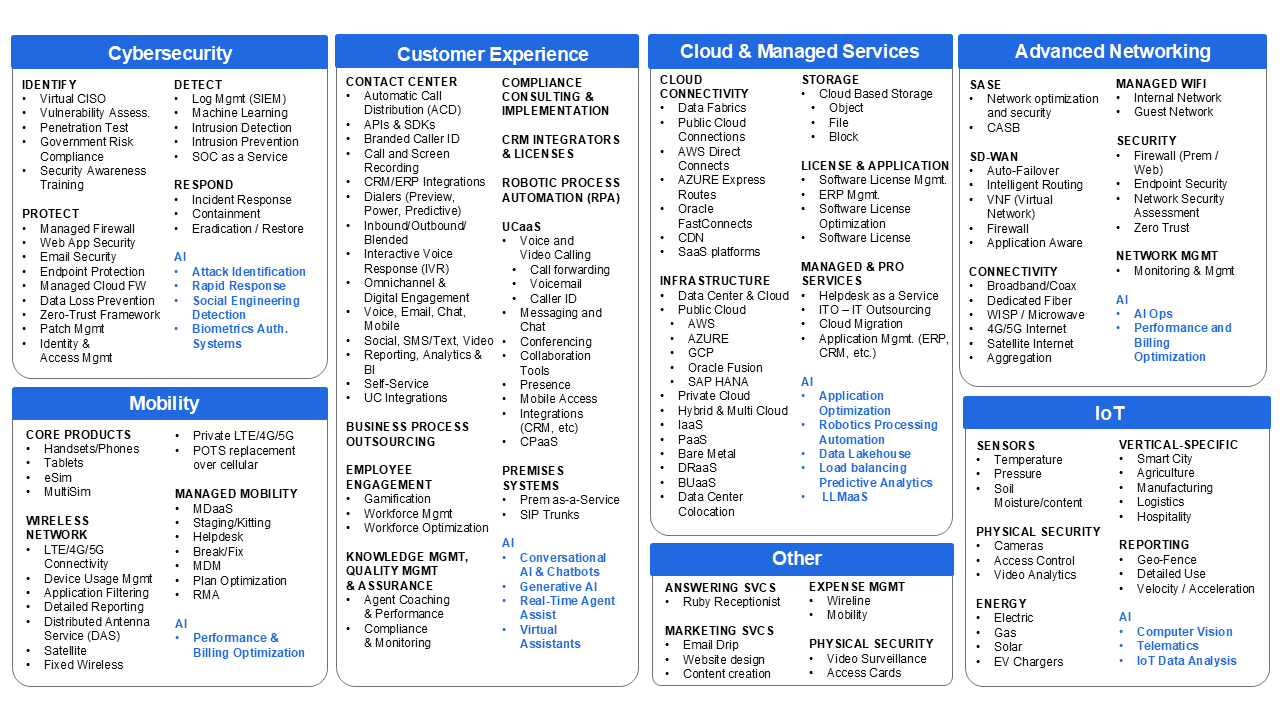
Convergence is not simply placing two applications under one contract. It means creating an architecture in which communications, customer experience, network performance, and governance reinforce one another.
A strong foundation includes four layers:
Communications
- Voice, video, messaging, presence, and meetings
- Contact center routing, IVR, queues, and agent workflows
- Shared telephony and identity where practical
Customer experience
- CRM integration
- Omnichannel interaction history
- Knowledge management and agent assistance
- Quality management and journey analytics
Network and connectivity
- SD-WAN policies that prioritize voice and video
- Resilient internet and carrier connectivity
- Quality-of-service monitoring
- Secure access across offices, branches, and remote locations
Governance
- Role-based access
- Recording and retention policies
- Data residency and compliance controls
- AI permissions, auditability, and lifecycle management
SD-WAN does not replace UCaaS or CCaaS integration. It provides the network intelligence required to deliver a consistent communications experience across locations and work modes.
TechStrategy Innovations helps organizations evaluate these layers together through technology strategy and transformation services. Our broader solutions portfolio connects enterprise connectivity, cloud modernization, unified communications, contact center transformation, and operational efficiency.
5. Choose integration: not just a logo
A single vendor can reduce complexity, but one logo does not automatically create one platform.
Some providers sell UCaaS and CCaaS products that share branding but still operate with separate administration, data models, support structures, or workflow logic. Evaluate the architecture, not the marketing label.
Ask vendors to demonstrate the following scenario:
- An agent receives a customer interaction.
- The agent needs help from an internal specialist.
- Presence identifies the right available expert.
- The expert joins without forcing a new customer transfer.
- Customer and interaction context remains visible.
- The CRM updates automatically.
- The interaction is recorded and governed under the right policy.
- AI generates a summary and triggers the next workflow.
If the vendor cannot demonstrate that sequence in a realistic environment, ask where manual effort or third-party integration is required.
Also evaluate:
- Open APIs and integration depth
- CRM, workforce management, and quality management compatibility
- Carrier and BYOC flexibility
- E911 and emergency communications
- Recording, retention, and compliance capabilities
- Data portability and exit requirements
- Support ownership across the full stack
- AI pricing, permissions, and data access
Research from a Forrester Total Economic Impact study modeled a 211% three-year ROI and a payback period of less than six months for a specific integrated RingCentral UCaaS and CCaaS deployment. The study evaluated a modeled composite organization, so it should inform your business case rather than replace your own financial analysis.
6. Deploy in phases
You do not need to replace every communication platform at once. A phased approach can reduce risk while allowing you to prove value.
Phase one: Map the friction
Document where work breaks today.
- Identify transfers, callbacks, and repeated data entry.
- Map the systems agents and specialists use during a customer interaction.
- Measure current FCR, CSAT, handle time, and escalation time.
- Calculate administrative and support costs across both platforms.
Phase two: Select a proving ground
Choose one customer journey, team, or location with measurable pain. Avoid starting with the most complex business unit unless it represents a critical strategic priority.
Define success metrics before deployment:
- Reduced transfer rate
- Faster expert access
- Higher first contact resolution
- Lower average handle time
- Improved agent adoption
- Reduced support tickets
- Lower cost per interaction
Phase three: Integrate the workflow
Connect the platforms around a real operating process. Do not stop at directory synchronization or click-to-dial.
Test routing, presence, CRM context, recording, reporting, automation, and escalation behavior together. Validate security and compliance controls before production use.
Phase four: Expand deliberately
Use the pilot results to refine training, governance, licensing, and network design. Then expand by journey, location, or user group.

7. Model the return
Your ROI model should connect technology changes to operational outcomes.
Use a simple framework:
Annual value = labor savings + avoided platform costs + improved retention or revenue − implementation and operating costs
Consider these value drivers:
- Fewer minutes spent per interaction
- Lower contact volume from improved resolution
- Reduced transfer and callback activity
- Fewer overlapping licenses and integrations
- Lower administrative effort
- Faster onboarding and provisioning
- Improved employee productivity
- Higher customer retention or expansion
- Lower risk from inconsistent governance
Do not assume every benefit will appear as a direct headcount reduction. In many mid-market organizations, the first benefit is capacity: teams can handle more demand without adding equivalent labor.
Think beyond the immediate license comparison. A converged foundation gives you more flexibility to deploy automation, AI assistance, intelligent routing, and customer journey analytics later.
Convergence is not a technology consolidation project. It is an operating model decision.
The strategic decision
UCaaS and CCaaS are still distinct categories. Your customers and employees, however, experience one connected business.
Keeping the platforms separate may preserve organizational boundaries, but it also preserves the friction between them. In 2026, that friction affects cost, customer satisfaction, agent productivity, reporting quality, and your ability to deploy useful AI.
Start with the break points. Map the data, workflows, network, and governance requirements. Then select an architecture that helps your teams resolve customer needs without forcing context to stop at the edge of the contact center.
TechStrategy Innovations can help you assess your current communications environment, develop a practical convergence roadmap, and align UCaaS, CCaaS, SD-WAN, and CX investments with measurable business outcomes. Schedule a strategic conversation.
Frequently asked questions
Is UCaaS replacing CCaaS?
No. UCaaS and CCaaS address different operational requirements. The strategic shift is toward integrating them so employees, agents, specialists, and customer interactions can operate within a connected workflow.
Should a mid-market company buy both platforms from one vendor?
It can be beneficial, but do not assume a single vendor means a unified architecture. Confirm whether the platforms share telephony, identity, administration, reporting, data, workflows, and support ownership.
Do you need to replace your existing UCaaS or CCaaS platform?
Not necessarily. A phased integration strategy may deliver value without an immediate rip-and-replace project. Begin by identifying the highest-cost customer and employee handoffs, then determine whether your existing platforms can support the required integration depth.
How does SD-WAN support UCaaS and CCaaS convergence?
SD-WAN helps prioritize and protect voice, video, and collaboration traffic across offices, branches, and remote environments. It supports the quality, resilience, and visibility required for a consistent communications experience, but it should be designed as part of the broader architecture rather than treated as a standalone fix.