
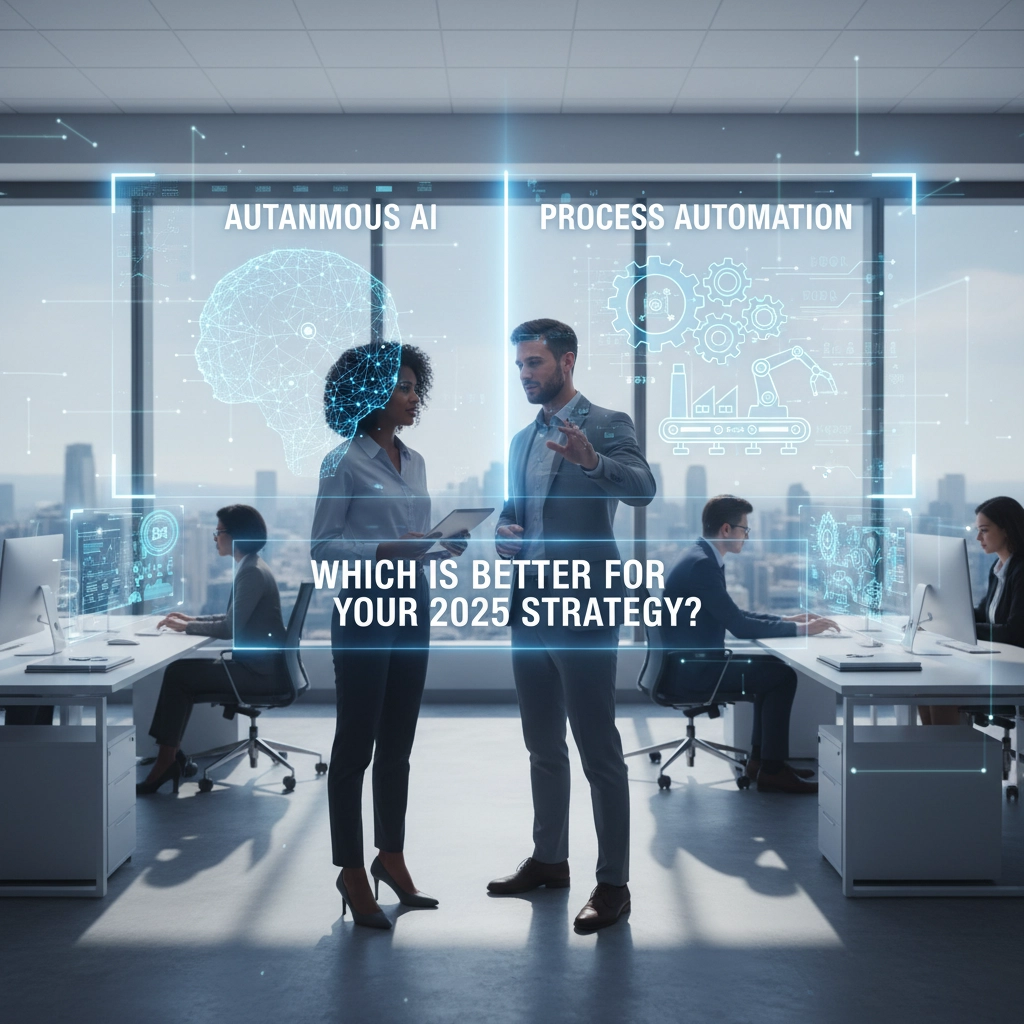
The automation landscape is shifting beneath our feet. What worked in 2023 won't cut it for 2025, and the stakes have never been higher. You're facing a critical choice that will define your operational efficiency for years to come: deploy autonomous AI systems that think and adapt, or leverage proven process automation that executes with precision.
This isn't just about choosing technology: it's about choosing your competitive positioning in an increasingly automated world.
The Autonomous AI Revolution: Beyond Rule-Based Thinking
Autonomous AI represents a fundamental shift from "if-then" logic to genuine decision-making capability. Unlike traditional automation, these systems don't just follow scripts: they understand context, learn from outcomes, and adapt their behavior in real-time.
What sets autonomous AI apart:
Contextual Decision-Making - These systems analyze multiple data sources simultaneously, making nuanced decisions that account for business context, not just pre-programmed rules
Continuous Learning - Every interaction becomes training data, enabling the system to improve its performance without human intervention
Multimodal Processing - Modern autonomous AI handles text, images, voice, and user interfaces seamlessly, breaking down the silos that limit traditional automation
Exception Handling - Rather than breaking when encountering unexpected scenarios, autonomous AI navigates ambiguity and finds solutions

The emergence of Agentic Process Automation (APA) in 2025 signals this evolution. These AI agents don't just automate tasks: they orchestrate entire business processes, making independent decisions that align with your strategic objectives.
Consider this reality: Your customer service inquiries vary dramatically in complexity, tone, and urgency. Traditional automation fails when faced with this variability, but autonomous AI thrives in it, understanding emotional context and adjusting responses accordingly.
Strategic advantages you'll gain:
• End-to-end process ownership - Single AI agents can manage complex workflows from initiation to completion • Dynamic adaptation - Systems adjust to changing business conditions without requiring reprogramming • Unstructured data mastery - Process emails, documents, images, and conversations with equal proficiency • Scalable intelligence - Deploy cognitive capabilities across your entire operation, not just routine tasks
Process Automation: The Foundation of Operational Excellence
Traditional process automation: encompassing Robotic Process Automation (RPA) and Intelligent Automation (IA): remains the backbone of efficient operations. These systems excel at what they were designed for: executing defined processes with unwavering consistency.
Core strengths that drive ROI:
Execution Speed - RPA systems operate 4-5x faster than human workers on repetitive tasks, delivering immediate productivity gains
Zero-Error Performance - Once configured correctly, these systems eliminate human error from routine processes
24/7 Operations - Your processes run continuously without breaks, sick days, or vacation time
Compliance Excellence - Complete audit trails and standardized execution ensure regulatory compliance

Where process automation dominates:
• Data entry and extraction - Moving information between systems with perfect accuracy
• Report generation - Creating standardized reports on schedule without manual intervention
• Invoice processing - Handling high-volume, standardized financial workflows
• System integrations - Connecting disparate systems that lack native integration capabilities
"Process automation doesn't replace human judgment: it frees humans to focus on activities that require judgment."
The key insight: process automation transforms your operational foundation, creating the stability and efficiency necessary for strategic initiatives. While it won't handle complexity or ambiguity, it eliminates the routine friction that slows down your organization.
Strategic Comparison: Making the Right Choice
| Dimension | Autonomous AI | Process Automation |
|---|---|---|
| Task Complexity | Complex, variable, judgment-required | Repetitive, rule-based, standardized |
| Implementation Speed | 3-6 months with infrastructure setup | 2-8 weeks for standard processes |
| Learning Capability | Continuously improves performance | Static unless manually updated |
| Error Handling | Adapts and resolves exceptions | Requires escalation for variations |
| Cost Structure | Higher upfront, lower long-term scaling | Lower upfront, higher scaling costs |
| Data Requirements | Handles unstructured, multimodal data | Requires structured, consistent inputs |
| ROI Timeline | 6-18 months for complex processes | 3-6 months for routine tasks |
The reality you need to understand: this isn't an either-or decision for most organizations. The most successful 2025 strategies combine both approaches strategically.

Your 2025 Decision Framework
Deploy Process Automation When:
You need quick wins - RPA delivers visible results within weeks, building momentum for broader automation initiatives
Your processes are standardized - High-volume, low-variation workflows are perfect candidates for traditional automation
Compliance is critical - Industries with strict regulatory requirements benefit from the audit trails and consistency of RPA
You're starting your automation journey - Build foundational capabilities before advancing to more complex AI implementations
Deploy Autonomous AI When:
Process variation is high - Customer service, content creation, and approval workflows benefit from AI's adaptability
You handle unstructured data - Documents, emails, images, and conversations require AI's comprehension capabilities
Decision-making is complex - Multi-factor decisions that consider context, history, and business rules
You're scaling strategically - Enterprise-wide transformation requires AI's ability to handle complexity at scale
Deploy Hybrid Approaches When:
You want comprehensive automation that addresses both routine efficiency and strategic capability building. Gartner predicts that 30% of enterprises will automate more than half their network activities by 2026 using hyperautomation: the integration of multiple automation technologies.
"The organizations that thrive in 2025 won't choose between AI and automation: they'll orchestrate both to create competitive advantages."
Implementation Strategy for Maximum Impact
Phase 1: Foundation Building (Months 1-3)
- Deploy RPA for high-volume, routine processes
- Establish automation governance and change management protocols
- Build internal automation capabilities and expertise
Phase 2: Intelligence Integration (Months 4-9)
- Introduce AI capabilities to enhance existing RPA workflows
- Implement intelligent document processing and natural language capabilities
- Begin pilot programs for autonomous AI in controlled environments
Phase 3: Strategic Deployment (Months 10-18)
- Scale autonomous AI to complex, strategic processes
- Develop custom AI agents for unique business requirements
- Create feedback loops for continuous improvement and learning

The key to success lies in your approach to change management. Your workforce needs to understand that automation amplifies human capabilities rather than replacing them. The most successful implementations involve employees in the automation design process, ensuring that their expertise guides the technology deployment.
Looking Forward: The Convergence Opportunity
The 2025 automation landscape isn't about choosing sides: it's about orchestrating multiple technologies to achieve strategic objectives. Organizations that deploy process automation for efficiency and autonomous AI for intelligence will create sustainable competitive advantages.
Critical success factors you can't ignore:
• Data quality and governance - Both approaches require clean, accessible data to function effectively • Integration architecture - Your systems must communicate seamlessly to support end-to-end automation • Continuous monitoring - Automated processes require ongoing performance monitoring and optimization • Cultural readiness - Success depends on organizational willingness to embrace new ways of working
The strategic imperative: Start with process automation to build operational efficiency, then layer autonomous AI capabilities to handle complexity and drive innovation. This approach minimizes risk while maximizing your potential for transformation.
"In 2025, the question isn't whether to automate: it's how strategically you can deploy automation to create lasting competitive advantage."
Your automation strategy should reflect your broader business strategy. If you're competing on operational efficiency, emphasize process automation. If you're differentiating through customer experience or innovation, prioritize autonomous AI capabilities.
The organizations that navigate this transition successfully will emerge with operations that are both efficient and intelligent: capable of handling routine work flawlessly while adapting to complex challenges with human-like judgment. That's not just automation; that's competitive transformation.
The choice is yours, but the window for strategic advantage is closing rapidly. Make your move now, or watch competitors leverage these capabilities to outmaneuver you in the marketplace.